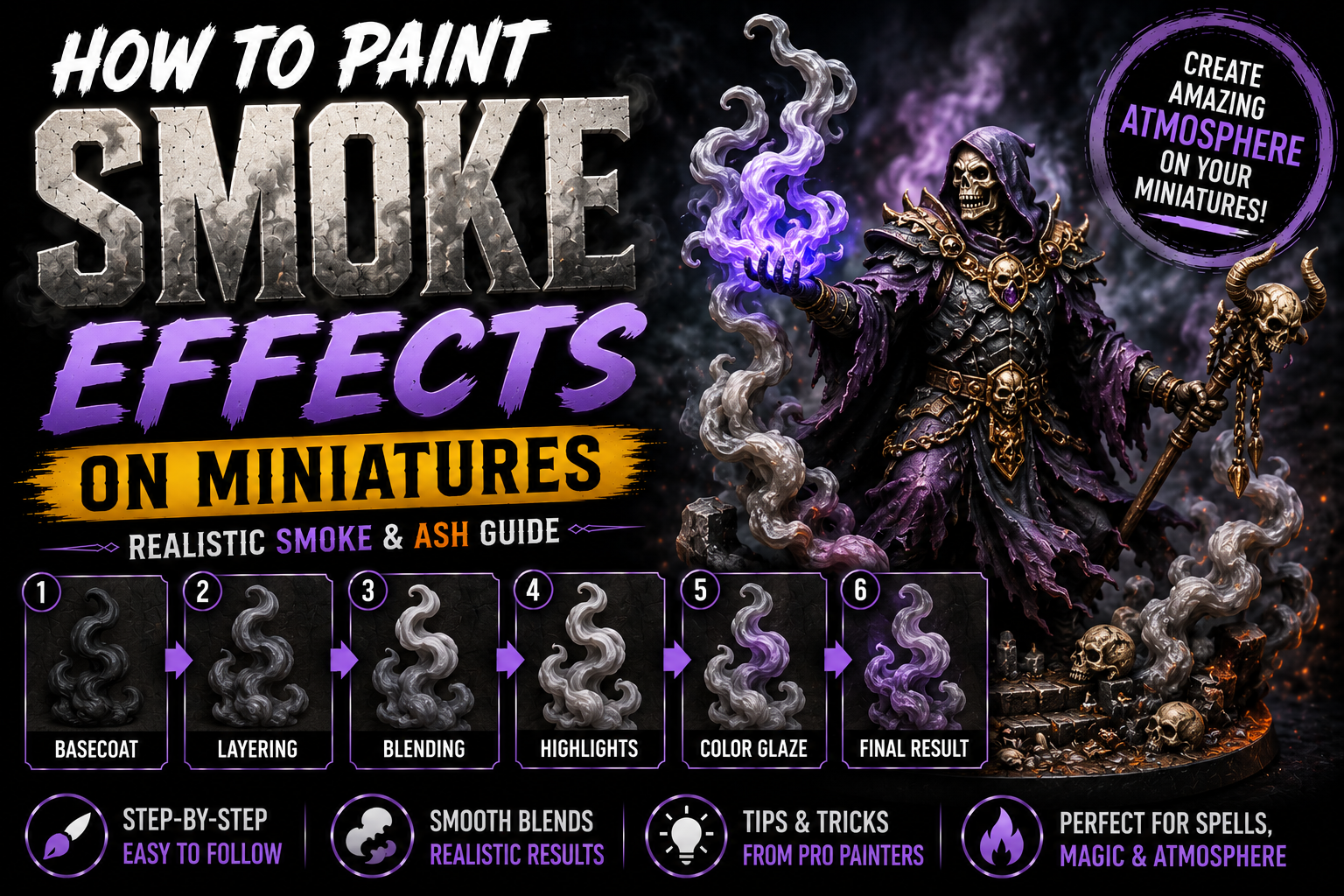
How to Paint Smoke Effects on Miniatures (Realistic Smoke & Ash Guide)

Smoke is one of the most dramatic special effects you can add to a fantasy miniature. Whether it’s rising from a magical spell, swirling around a necromancer, pouring from a dragon’s mouth, or drifting from a battlefield, realistic smoke adds movement and atmosphere that instantly elevates a model.
Unlike solid objects, smoke has no hard edges. It constantly fades, twists, and changes density, making smooth color transitions far more important than sharp highlights.
In this guide, you’ll learn how to paint convincing smoke effects using layering, glazing, and subtle lighting techniques that work on spells, scenery, monsters, and magical miniatures.
Understanding How Smoke Behaves

Before painting, observe real smoke.
Smoke is denser near its source and gradually becomes lighter and more transparent as it rises. It rarely forms straight lines, instead flowing in soft curls and irregular shapes.
Light interacts gently with smoke, creating smooth transitions instead of sharp reflections.
Keeping these characteristics in mind will make your painted effects feel much more natural.
Choosing the Right Color Palette

A realistic smoke palette usually includes:
- Black
- Charcoal Grey
- Neutral Grey
- Light Grey
- Blue Grey
- Ivory
For magical smoke, you can also introduce subtle hints of:
- Purple
- Green
- Cyan
- Crimson
Use these colors sparingly to preserve the smoky appearance.
Painting the Base Coat

Start with your darkest color near the source of the smoke.
Gradually transition toward lighter greys as the smoke rises or expands.
Apply multiple thin coats rather than one heavy layer to preserve every sculpted swirl.
Smooth gradients are the foundation of convincing smoke.
Creating Soft Transitions

Smoke should never appear striped.
Blend each shade gently into the next using thin glazes.
Allow dark greys, medium greys, and pale highlights to overlap naturally.
The smoother the blend, the more realistic the smoke will appear.
Adding Light and Volume

Highlight only the raised outer edges where light naturally catches the smoke.
Use light grey instead of pure white for most highlights.
Reserve tiny touches of ivory for only the highest points.
This creates the illusion of soft, floating volume.
Painting Magical Smoke

Fantasy smoke allows much more creativity.
Necromantic magic often uses green or purple glazes.
Arcane spells look fantastic with blue-grey smoke illuminated from within.
Fire magic can transition from orange near the source into dark grey ash.
Keep the magical colors subtle so the smoke still feels believable.
Combining Smoke with OSL

Smoke beautifully reflects nearby magical light.
If your miniature includes glowing crystals, enchanted weapons, or magical spells, lightly glaze the nearby smoke with the same color.
The glow should remain strongest near the light source before fading smoothly into neutral grey.
This creates an impressive sense of depth.
Common Mistakes to Avoid
Avoid these common mistakes:
- Using pure black across the entire smoke effect.
- Creating harsh color transitions.
- Over-highlighting with white.
- Ignoring the direction of the smoke.
- Applying thick paint.
- Making every swirl equally bright.
Smoke should always feel soft and fluid.
Final Thoughts
Smoke effects add motion, mystery, and atmosphere to fantasy miniatures. By combining gentle blending, subtle highlights, transparent glazes, and thoughtful lighting, you can create magical spells, battlefield smoke, dragon breath, and supernatural effects that immediately capture attention.
Once mastered, smoke painting becomes one of the most versatile techniques in your miniature painting toolkit.
Frequently Asked Questions
What’s the easiest smoke color for beginners?
Neutral grey blended into light grey is the simplest and most forgiving combination.
Should smoke always be black?
No. Most smoke contains multiple shades of grey, and magical smoke can include subtle colored glazes.
Can I add OSL to smoke?
Absolutely. Smoke reflects nearby light beautifully, making it perfect for magical lighting effects.
How do I make smoke look soft?
Use several thin glazes to blend transitions smoothly instead of relying on harsh highlights.
What’s the biggest mistake when painting smoke?
Using solid black without creating gradual transitions toward lighter tones.
If you would like free D&D STL miniatures, visit our homepage and download yours now:https://echoartstudios.net/