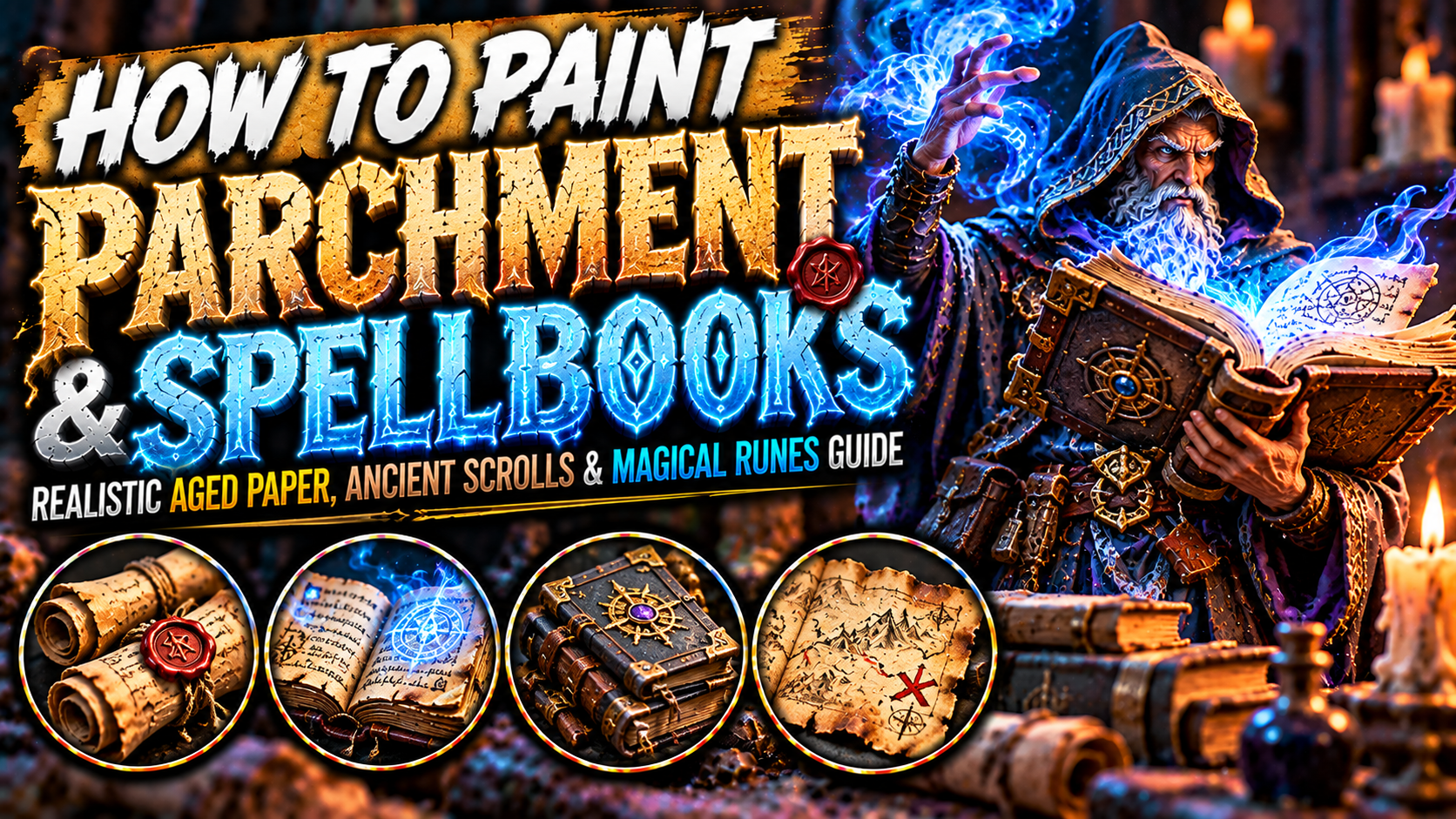
How to Paint Parchment and Spellbooks on Miniatures (Realistic Aged Paper, Ancient Scrolls & Magical Runes Guide)
Parchment and spellbooks are some of the most recognizable accessories on fantasy miniatures.
Whether you’re painting a powerful wizard holding an ancient grimoire, a cleric carrying sacred scriptures, a necromancer studying forbidden knowledge, or an adventurer examining an old treasure map, realistic paper effects can add an incredible amount of storytelling to your miniature.
Unlike metal, stone, or leather, parchment is a relatively soft material with subtle textures and gentle color transitions.
Its appearance changes depending on age, exposure, and environmental conditions.
Fresh parchment may appear pale cream or ivory.
Ancient scrolls often develop yellow-brown discoloration, darker edges, stains, and irregular wear.
Magical spellbooks introduce additional possibilities.
Glowing runes, enchanted pages, supernatural symbols, and mysterious illustrations can transform an ordinary book into a powerful fantasy artifact.
Creating convincing parchment requires more than painting a flat beige surface.
You need to understand natural paper colors, controlled shading, realistic aging, tiny lettering, edge highlights, weathering, and magical Object Source Lighting (OSL).
In this guide, you’ll learn how to paint realistic parchment, ancient scrolls, spellbook pages, handwritten text, magical runes, leather-bound grimoires, wax seals, treasure maps, and cinematic fantasy book effects.

Understanding How Parchment Looks
Parchment has a distinctive appearance that separates it from ordinary cloth, bone, or stone.
Historically, parchment was commonly produced from prepared animal skin.
Its surface can contain subtle variations in color, texture, and translucency.
In miniature painting, these details are represented through carefully controlled shading and highlights.
The most important characteristic is its warm, slightly uneven appearance.
Parchment rarely looks completely pure white.
Instead, it often contains ivory, beige, cream, tan, and pale brown.
Older parchment may develop darker edges and irregular stains.
Folded scrolls also contain shadows where the material bends.
These shadows help establish the thickness and shape of the paper.
For convincing results, avoid painting parchment as a perfectly uniform surface.
Subtle variation creates depth and realism.

Choosing the Best Parchment Color Palette
Different types of parchment require different color combinations.
Fresh paper should appear relatively bright.
Ancient scrolls benefit from warmer brown tones.
Forbidden grimoires can use darker, dirtier parchment.
Sacred manuscripts may contain pale ivory and gold.
| Parchment type | Color progression |
|---|---|
| Fresh parchment | Tan → Beige → Cream → Ivory |
| Ancient parchment | Dark Brown → Ochre → Bone → Pale Beige |
| Weathered scroll | Umber → Warm Brown → Khaki → Ivory |
| Sacred manuscript | Warm Grey → Cream → Ivory → White |
| Cursed parchment | Black-Brown → Grey-Brown → Dirty Beige → Bone |
| Magical pages | Dark Blue-Grey → Pale Blue → Ivory → White |
Choose colors that complement the miniature.
For example, warm parchment creates strong contrast against dark blue wizard robes.
Pale ivory pages look excellent inside black leather spellbooks.
Ancient brown scrolls work beautifully on adventurers wearing leather equipment.
Avoid using pure white as the main parchment color.
Reserve it for the brightest highlights.

Preparing the Miniature for Parchment Effects
Before painting parchment, examine the sculpted details.
Identify folds, curled edges, rolled sections, and any visible writing.
For an open spellbook, determine where the pages meet the spine.
For a scroll, identify the outer edges and rolled ends.
For hanging parchment, observe how the material bends and folds.
These details determine where shadows and highlights should appear.
Begin with a smooth primer coat.
Avoid applying thick paint.
Small parchment accessories can lose detail quickly.
If the miniature contains extremely fine sculpted writing, thin paint is especially important.
For larger books, you may also decide where to add freehand symbols or illustrations.
Planning these details before painting can make the final result much cleaner.

Painting the Dark Parchment Base
Begin with a medium-dark brown or tan.
For aged parchment, use warm brown.
For cleaner paper, use beige or light tan.
Apply the basecoat evenly.
Make sure the paint reaches the folds and recesses.
These darker areas will establish depth.
For open books, keep the central spine slightly darker.
For rolled scrolls, allow shadows to remain beneath the curled sections.
Avoid using pure black unless you’re painting an extremely dark or corrupted manuscript.
A warm brown foundation generally creates a more natural appearance.
Once the basecoat is dry, begin building lighter colors.

Building Smooth Parchment Highlights
Parchment usually benefits from smooth layering rather than heavy dry brushing.
Begin with your dark base.
Introduce a medium beige.
Apply it across the broad surfaces while leaving darker paint in the recesses.
Next, add cream.
Concentrate this color on raised areas and exposed sections.
Finish with small ivory highlights.
For folded parchment, place the brightest highlights along the raised folds.
Keep the deeper folds darker.
For flat pages, use subtle transitions rather than dramatic highlights.
Thin layers help preserve the smooth appearance of the material.
Avoid excessive texture.
Parchment should generally look softer than stone or rough leather.

Painting Realistic Aged Parchment
Ancient parchment should appear worn without becoming completely brown.
Begin with dark ochre or warm brown.
Introduce tan across the main surface.
Then build toward bone or cream.
Keep darker colors near the edges and folds.
You can add small irregular stains using very thin brown paint.
Avoid making every stain equally dark.
Some should be barely visible.
Others can appear more pronounced.
For a centuries-old manuscript, introduce subtle grey-brown discoloration.
Keep the central writing area relatively readable.
The goal is to create the appearance of old paper while preserving enough contrast for lettering and illustrations.

Creating Dark Weathered Paper Edges
Darkened edges are one of the easiest ways to make parchment appear old.
Begin with your normal parchment colors.
Then mix a thin brown glaze.
Apply it carefully near selected edges.
Allow the color to fade toward the center.
Avoid creating a perfectly uniform dark border.
Natural aging often produces irregular discoloration.
Some corners can be darker than others.
For heavily weathered scrolls, introduce small dark brown marks along damaged sections.
Keep the brightest parchment color visible toward the center.
This contrast creates a convincing aged appearance.

Painting Rolled Scrolls
Rolled scrolls are common accessories on wizards, clerics, scholars, and adventurers.
Their cylindrical shape creates distinctive shadows.
Begin with a warm brown base.
Introduce beige across the exposed surfaces.
Highlight the outer curves with cream.
Keep the interior of the rolled sections darker.
For a tightly rolled scroll, the ends may reveal several layers of parchment.
Use thin dark lines to separate these layers.
Then add small ivory highlights.
Avoid making every layer equally bright.
The outermost surfaces should generally receive stronger illumination.
You can also introduce subtle weathering near the exposed ends.

Painting Open Spellbook Pages
Open spellbooks provide an excellent opportunity to practice realistic parchment effects.
Begin with a dark tan base.
Paint the main page surfaces using beige.
Then introduce cream highlights.
Keep the central spine darker.
The edges of the pages can receive pale ivory highlights.
For thick books, paint thin dark lines along the exposed page stack.
These suggest individual sheets.
Avoid making the lines excessively thick.
For larger spellbooks, you can introduce subtle color differences between the left and right pages.
This creates additional visual interest.
Once the parchment is complete, you can begin painting writing and magical symbols.

Painting Tiny Handwritten Text
Tiny writing can make a spellbook look incredibly detailed.
However, painting actual readable words is usually unnecessary at tabletop scale.
Instead, create the illusion of handwriting.
Use a fine brush with a sharp point.
Choose dark brown or dark grey.
Paint several short horizontal lines.
Vary their lengths.
Leave small gaps between them.
Avoid making every line perfectly identical.
For a larger book, you can introduce occasional taller marks to suggest capital letters.
Keep the writing aligned with the page.
If the page curves, the text should follow that curvature.
Don’t cover the entire page with writing.
Small empty margins help the manuscript appear more realistic.

Painting Ancient Runes and Symbols
Ancient runes can make a spellbook feel mysterious and powerful.
Begin by choosing a consistent symbol style.
Angular runes work well for dwarven or ancient magical writing.
Curved symbols can suggest elven or arcane scripts.
Use a dark color for ordinary ink.
For magical runes, use a saturated color such as blue, purple, green, or red.
Paint the symbols with thin controlled strokes.
Avoid making them too large.
For a small spellbook, a few recognizable symbols are often enough.
You can also paint a larger central rune surrounded by smaller markings.
This creates a clear focal point.

Painting Glowing Blue Magical Runes
Glowing blue runes are perfect for arcane spellbooks and enchanted manuscripts.
Begin with dark blue symbols.
Then introduce saturated blue.
Add cyan highlights.
Finish selected sections with pale blue or white.
Keep the brightest highlights small.
You can also apply subtle blue glazes around the symbols.
This creates the impression that the runes are illuminating the parchment.
Avoid covering the entire page with bright blue.
The parchment should remain visible.
For additional realism, introduce faint blue reflections along the book’s central spine and nearby fingers.
The magical symbols should remain brighter than the surrounding surfaces.

Painting Purple Forbidden Magic
Purple magical writing creates a supernatural atmosphere.
It works especially well for warlocks, necromancers, witches, and eldritch scholars.
Begin with dark violet.
Introduce saturated purple.
Then add magenta.
Finish with pale lavender or pink highlights.
You can paint a central magical symbol surrounded by smaller runes.
Keep the surrounding parchment relatively dark.
For a glowing effect, apply thin violet glazes around the writing.
The strongest illumination should remain near the symbols.
Purple magic looks particularly effective inside dark leather-bound books.

Painting Green Necromantic Spellbooks
Green magical writing is ideal for cursed grimoires, undead sorcerers, and necromantic artifacts.
Begin with dark green.
Introduce emerald.
Build toward lime green.
Finish selected sections with pale yellow-green.
Keep the deepest recesses dark.
For an especially sinister appearance, use dirty beige parchment.
You can also introduce subtle green stains around the magical symbols.
Avoid making the entire book uniformly green.
The contrast between aged parchment and supernatural writing creates a stronger effect.
Nearby fingers and clothing can receive faint green reflections.

Painting Sacred Golden Manuscripts
Sacred books and religious manuscripts can benefit from warm golden details.
Begin with pale parchment.
Paint selected symbols using dark ochre.
Introduce golden yellow.
Then add pale yellow highlights.
For metallic decorations, use a dark metallic gold base followed by brighter highlights.
You can also paint small illuminated borders around the pages.
These decorative patterns work beautifully for clerics, paladins, and holy scholars.
Keep the design controlled.
Too many bright decorations can make the page difficult to read.
For a divine magical effect, introduce subtle warm reflections around the book.

Painting Leather-Bound Spellbooks
Leather covers provide an excellent contrast to pale parchment.
Begin with dark brown.
Introduce medium brown across the raised surfaces.
Then add tan edge highlights.
Keep the deepest recesses dark.
For weathered leather, introduce small scratches using pale brown.
Avoid making every scratch identical.
Concentrate wear along corners and exposed edges.
For black leather, begin with near-black.
Introduce dark grey highlights.
Finish with subtle pale grey edge highlights.
You can also paint metallic corner protectors and decorative clasps.
The contrast between matte leather, bright metal, and pale parchment creates a convincing fantasy accessory.

Painting Decorative Book Covers
Fantasy spellbooks often contain elaborate symbols, embossed designs, and magical decorations.
Begin by painting the cover’s main material.
Then identify the raised details.
For embossed leather, use a slightly lighter version of the cover color.
Highlight the upper edges.
Keep the surrounding recesses darker.
For metallic decorations, use gold, silver, or bronze.
A central gemstone can provide a strong focal point.
You can also paint a small magical symbol on the cover.
Avoid overcrowding the design.
A few carefully placed details often look more convincing than excessive decoration.

Painting Wax Seals on Scrolls
Wax seals are excellent details for magical letters, official documents, and ancient scrolls.
Begin with a dark version of the wax color.
For red wax, use burgundy.
Introduce crimson.
Then add small bright red highlights.
Keep the recesses darker.
If the seal contains a sculpted symbol, highlight the raised details carefully.
For purple wax, use dark violet and magenta.
For green wax, use dark green and emerald.
Avoid making wax excessively glossy.
A satin finish can create a convincing appearance.
The seal should remain visually distinct from the parchment.

Painting Ancient Treasure Maps
Treasure maps are excellent accessories for adventurers, pirates, explorers, and fantasy merchants.
Begin with aged parchment colors.
Introduce darkened edges and subtle stains.
Then paint simple geographical markings.
Use thin brown lines to suggest coastlines, rivers, or roads.
Add small symbols for mountains, forests, or ruins.
For a larger map, you can paint a tiny compass rose.
Keep the markings simple.
At miniature scale, readability is more important than complexity.
You can also introduce a small red symbol to mark a destination.
The contrast between the aged parchment and the map details creates an interesting storytelling element.

Painting Burned and Damaged Parchment
Burned parchment can suggest dangerous magic, ancient battles, or forbidden rituals.
Begin with normal parchment colors.
Then introduce dark brown near the damaged areas.
Add black-brown to selected edges.
Keep the transitions irregular.
Avoid painting a perfectly even black border.
Realistic scorching often produces uneven discoloration.
You can also paint small missing sections along the edges.
For a partially burned scroll, keep the center relatively intact.
The strongest damage should remain concentrated near the affected areas.
A few warm orange-brown marks can suggest recent scorching.

Painting Dirty and Stained Spellbook Pages
Old spellbooks may contain stains from moisture, dirt, ink, or magical substances.
Begin with your normal parchment colors.
Then apply very thin brown glazes in irregular patches.
Keep the stains subtle.
Some can appear near the corners.
Others can extend across the page.
For water damage, use soft brown-grey transitions.
For ink stains, use dark brown or black.
For magical contamination, introduce muted purple, green, or blue.
Avoid covering important writing.
The stains should enhance the aged appearance without overwhelming the page.

Creating Object Source Lighting from Spellbooks
Object Source Lighting can transform an ordinary spellbook into a powerful magical artifact.
Imagine a wizard holding an open book filled with glowing blue runes.
The pages act as a light source.
Nearby fingers, hands, robes, and facial features may reflect the magical color.
Begin with thin blue glazes.
Apply them to surfaces facing the book.
Keep the strongest reflections closest to the pages.
Gradually reduce the brightness farther away.
The runes should remain brighter than the surrounding miniature.
For green magic, use emerald and pale green reflections.
For purple magic, use violet and magenta.
For sacred golden magic, use warm yellow and ivory.
Avoid illuminating every surface equally.
Directional lighting creates a more convincing magical effect.

Painting Floating Magical Pages
Floating pages can create a dramatic fantasy effect.
They work beautifully for powerful wizards, magical libraries, and supernatural creatures.
Begin by painting each page using your normal parchment colors.
Then introduce small runes or handwritten markings.
Keep the edges slightly darker.
For magical pages, add subtle colored highlights.
You can also paint glowing symbols on selected sheets.
Avoid making every page equally bright.
Some can remain ordinary parchment.
Others can contain concentrated magical energy.
This variation creates a more interesting composition.
If the pages are sculpted around a character, consider their movement and orientation.
The arrangement should suggest swirling magical energy.

Painting Spellbooks on Miniature Bases
Spellbooks can also become environmental storytelling elements.
An abandoned wizard’s study might contain scattered manuscripts.
A dungeon base could feature a forgotten grimoire.
A magical altar might contain an open book surrounded by candles and runes.
Paint the book using a consistent parchment technique.
Then introduce weathering appropriate to the environment.
For a dusty library, use muted beige and grey-brown.
For a damp dungeon, add subtle dark stains.
For a magical altar, introduce glowing symbols and reflected light.
Keep the book integrated with the surrounding scenery.
A small amount of dust or debris around the edges can help it appear naturally placed.

Creating Cinematic Magical Book Effects
A spellbook can become the main focal point of an entire miniature.
To achieve this, concentrate the brightest colors around the pages.
Keep the surrounding environment relatively dark.
Use a strong contrast between warm parchment and cool magical energy.
For example, pale ivory pages combined with bright cyan runes can create a dramatic arcane appearance.
Purple runes can introduce mystery.
Green magic can suggest necromancy.
Golden symbols can communicate divine power.
Apply subtle reflected light to nearby surfaces.
You can also introduce small magical particles around the book.
Keep these effects restrained.
The goal is to make the spellbook appear powerful without hiding the miniature itself.

Common Mistakes When Painting Parchment and Spellbooks
One of the most common mistakes is painting parchment pure white.
This removes much of its warmth and aged appearance.
Use beige, cream, ivory, and subtle brown instead.
Another mistake is applying heavy dark washes across the entire page.
This can make the parchment appear dirty and obscure small details.
Avoid painting handwriting with thick lines.
Tiny irregular marks usually look more convincing.
Don’t make every rune equally bright.
Magical effects benefit from variation in intensity.
Another problem is painting the entire spellbook with the same color.
The cover, pages, metal decorations, and magical symbols should remain visually distinct.
Finally, avoid excessive OSL.
The magical source should remain brighter than the surrounding reflections.

Final Thoughts
Painting convincing parchment and spellbooks requires warm color transitions, subtle weathering, controlled highlights, fine freehand details, and thoughtful magical lighting.
Start with a dark tan or brown foundation.
Gradually build toward beige, cream, and ivory.
Keep the deepest folds and recesses darker.
Introduce irregular stains and weathered edges where appropriate.
For scrolls, emphasize the curved surfaces and rolled ends.
For open spellbooks, keep the central spine darker and highlight the exposed pages.
Use tiny irregular marks to create the illusion of handwriting.
For magical manuscripts, introduce glowing runes using saturated colors and bright highlights.
Blue works beautifully for arcane magic.
Purple creates an eldritch atmosphere.
Green suggests necromancy.
Gold can represent divine or sacred power.
Add subtle Object Source Lighting when the book is intended to emit magical energy.
These techniques work beautifully for wizards, sorcerers, clerics, necromancers, witches, scholars, adventurers, magical libraries, ancient temples, and fantasy dioramas.
The most important principle is that parchment should look like a delicate, aged material rather than a flat painted surface.
Its color variation, folds, writing, and weathering should communicate history.
When painted effectively, even a tiny scroll or spellbook can become one of the most memorable details on an entire miniature.
Frequently Asked Questions
What colors should I use for realistic parchment?
Warm brown, tan, beige, cream, bone, and ivory create an effective parchment color progression.
How do I paint aged parchment on miniatures?
Begin with a warm brown base, build toward cream highlights, and introduce subtle stains and darker edges.
How do I paint tiny writing on spellbooks?
Use a fine brush to paint short irregular horizontal lines rather than attempting fully readable text at tabletop scale.
What is the best color for ancient scrolls?
Ochre, tan, bone, and pale beige work beautifully for old parchment.
How do I paint glowing magical runes?
Paint the symbols using a dark saturated color, gradually build brighter highlights, and finish selected areas with pale or white details.
How do I paint realistic leather spellbook covers?
Start with dark brown, add medium brown highlights, and finish with small tan edge highlights and subtle scratches.
How do I paint burned parchment?
Use dark brown and black-brown near damaged edges, keeping the discoloration irregular and the center relatively lighter.
How do I create OSL from a magical spellbook?
Apply thin glazes of the magical color to nearby hands, clothing, and facial features, keeping the strongest reflections closest to the pages.
If you would like free D&D STL miniatures, visit our homepage and download yours now: