How to Paint Demon Skin on Miniatures (Realistic Infernal Flesh Guide)

Demon skin is one of the most striking surfaces you can paint on a fantasy miniature. Deep reds, unnatural shadows, glowing areas, horns, scars, and dramatic highlights give you far more creative freedom than ordinary human skin.
But painting a demon entirely bright red often produces a flat, toy-like result.
Convincing infernal flesh needs variation. Dark burgundy shadows, saturated red midtones, purple undertones, orange highlights, and subtle changes across the body can make the creature feel much more believable.
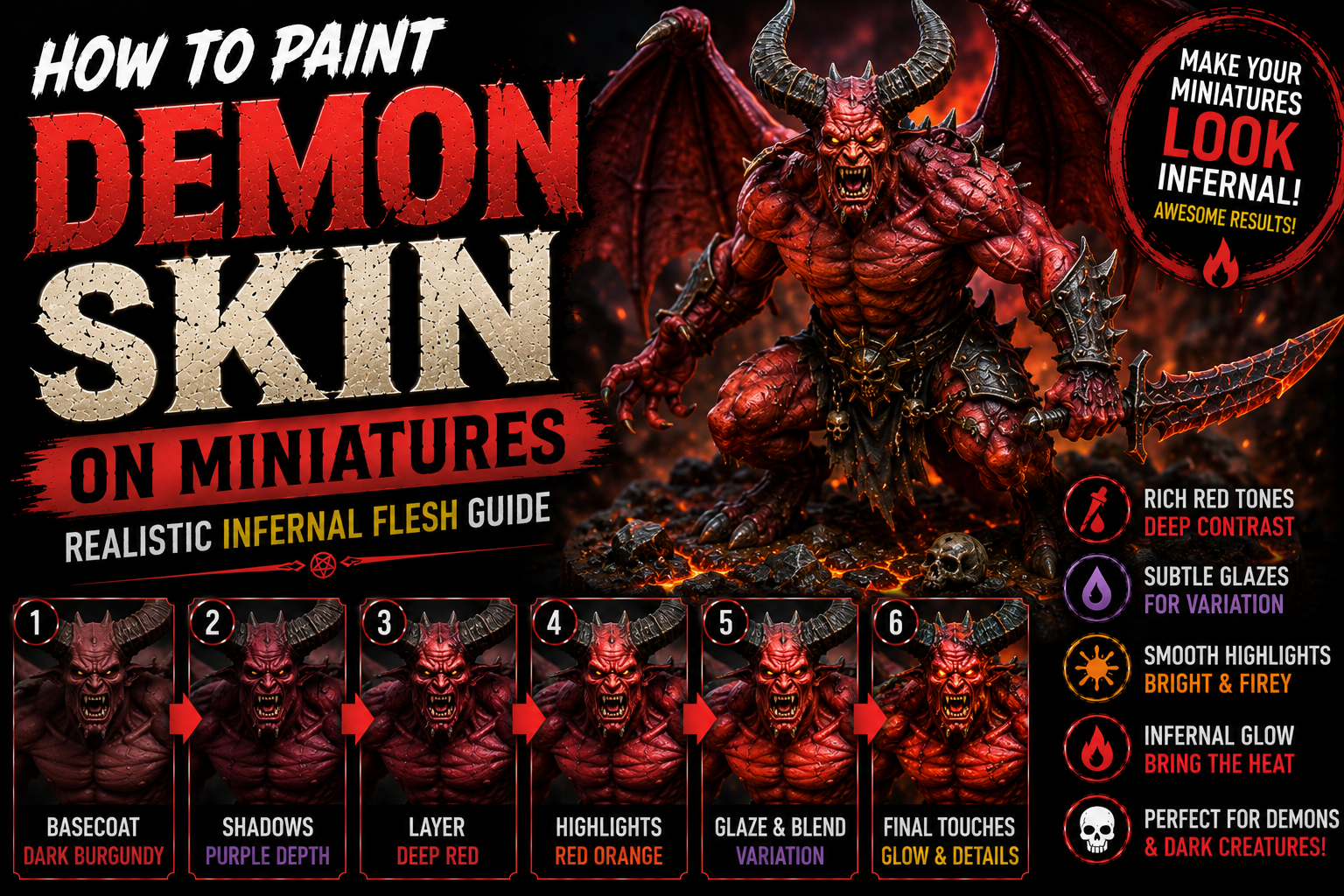
In this guide, you’ll learn how to paint realistic demon skin using layering, glazing, color variation, highlighting, and infernal lighting techniques.
Understanding Demon Skin

Fantasy gives you freedom, but believable skin still needs structure.
Muscles, wrinkles, veins, scars, and stretched areas should react differently to light.
Raised muscles receive stronger highlights, while areas beneath the chest, arms, jaw, and abdominal muscles remain significantly darker.
Instead of treating the demon as one large red surface, think of the body as a collection of volumes.
This immediately creates more depth.
Choosing Your Demon Skin Palette

A strong infernal palette can include:
- Dark Burgundy
- Crimson
- Deep Red
- Bright Red
- Red-Orange
- Purple
- Pale Orange
Start much darker than your final desired color.
This gives you room to gradually increase brightness while preserving strong shadows.
Purple and burgundy are especially useful because they create rich shadows without making the skin look dirty.
Painting the Base Coat

Begin with a dark red or burgundy base.
Apply several thin coats until the surface is smooth while keeping every sculpted detail visible.
Don’t begin with your brightest red.
A darker foundation creates natural depth inside muscles, wrinkles, and recesses.
Once the base is completely dry, you can gradually introduce brighter red tones.
Building Deep Infernal Shadows

Demon skin looks especially dramatic with deep colored shadows.
Mix dark red with small amounts of purple or dark brown.
Concentrate these shadows around:
- Under the jaw
- Between muscles
- Around the ribs
- Beneath the arms
- Inside wrinkles
- Around horns
- Between fingers
Avoid pure black whenever possible.
Colored shadows preserve the richness of the red skin while still creating powerful contrast.
Building the Red Midtones

Now begin restoring the main red color.
Apply increasingly brighter reds across raised muscles while leaving your darker shadows visible underneath.
Each new layer should cover slightly less surface area.
This creates natural transitions from burgundy shadows into saturated red skin.
Thin paint is especially important here.
Several transparent layers create much smoother results than one thick coat.
Adding Color Variation

Realistic fantasy skin becomes much more interesting when it contains subtle variations.
Apply thin purple glazes around colder shadow areas.
Introduce orange-red around exposed muscles and areas receiving stronger light.
Small amounts of brown can be added around elbows, hands, feet, and rough skin.
You can even introduce subtle dark blue or violet tones around extremely deep shadows.
Keep these colors transparent.
They should influence the red rather than replace it.
Highlighting Demon Muscles

Demon miniatures often have exaggerated anatomy, making highlights especially important.
Focus brighter red-orange colors on:
- Shoulders
- Chest
- Upper arms
- Forehead
- Cheekbones
- Knuckles
- Upper thighs
Gradually reduce the size of each highlight.
For the brightest areas, mix a small amount of pale orange or warm ivory into your red.
Avoid jumping directly to white.
Warm highlights preserve the fiery appearance of the skin.
Painting Horns and Claws

Horns create an excellent contrast against red skin.
Start with dark brown or nearly black near the base.
Gradually transition toward beige, ivory, or pale bone near the tips.
Thin horizontal lines can simulate natural horn growth.
Claws can follow the same principle.
Keeping horns relatively neutral also prevents them from competing visually with the demon’s skin.
Adding Infernal Glow

For a more supernatural demon, add glowing infernal energy.
Orange or yellow light can appear inside cracks, eyes, magical symbols, or wounds sculpted into the creature.
Start with deep orange and gradually work toward yellow and pale yellow at the brightest point.
Then glaze surrounding red skin with transparent orange.
This creates the illusion that intense heat is glowing from inside the demon.
The effect works particularly well on large demons and boss miniatures.
Painting Demon Faces and Eyes

The face should usually receive your strongest contrast.
Deepen the eye sockets and areas beneath the cheekbones before carefully highlighting the forehead, nose, eyebrows, and jaw.
For supernatural eyes, yellow, orange, green, or pale blue can create striking contrast against red skin.
Keep the center of glowing eyes extremely bright.
A subtle glaze around the eyelids can also suggest that magical light is reflecting onto the surrounding skin.
Common Mistakes to Avoid

Avoid these common mistakes:
- Painting the entire demon one shade of red.
- Using black for every shadow.
- Highlighting red directly with white.
- Ignoring muscle structure.
- Making every area equally bright.
- Using overly thick glazes.
- Adding too many competing magical colors.
Strong contrast and controlled color variation will produce much more convincing infernal flesh.
Final Thoughts
Painting demon skin gives you enormous freedom to experiment with color while still practicing the fundamentals of realistic miniature painting.
Start with deep burgundy shadows, gradually introduce saturated reds, build warm highlights, and use subtle purple and orange glazes to create variation.
Then enhance the character with horns, claws, glowing eyes, or infernal energy effects.
These techniques work beautifully on demons, devils, tiefling-inspired creatures, corrupted warriors, infernal bosses, and countless D&D miniatures.
The goal isn’t simply to paint the creature red.
It’s to make that red skin feel alive, dimensional, and illuminated by the infernal world the creature came from.
Frequently Asked Questions
What’s the best base color for demon skin?
Dark burgundy or deep crimson creates an excellent foundation for traditional red demon skin.
What’s the best color for demon shadows?
Purple, burgundy, and dark brown produce rich shadows without destroying the saturation of the red.
How should I highlight red skin?
Gradually mix brighter reds with red-orange or pale orange rather than immediately adding white.
Can demon skin have colors other than red?
Absolutely. Purple, blue, grey, black, green, and pale flesh can all create fantastic demon designs.
How do I make a demon look like it’s glowing from inside?
Paint cracks or magical areas orange and yellow, then add subtle orange OSL to the surrounding skin.
What’s the biggest mistake when painting demons?
Using a single red across the entire creature without enough variation between shadows, midtones, and highlights.
If you would like free D&D STL miniatures, visit our homepage and download yours now: